
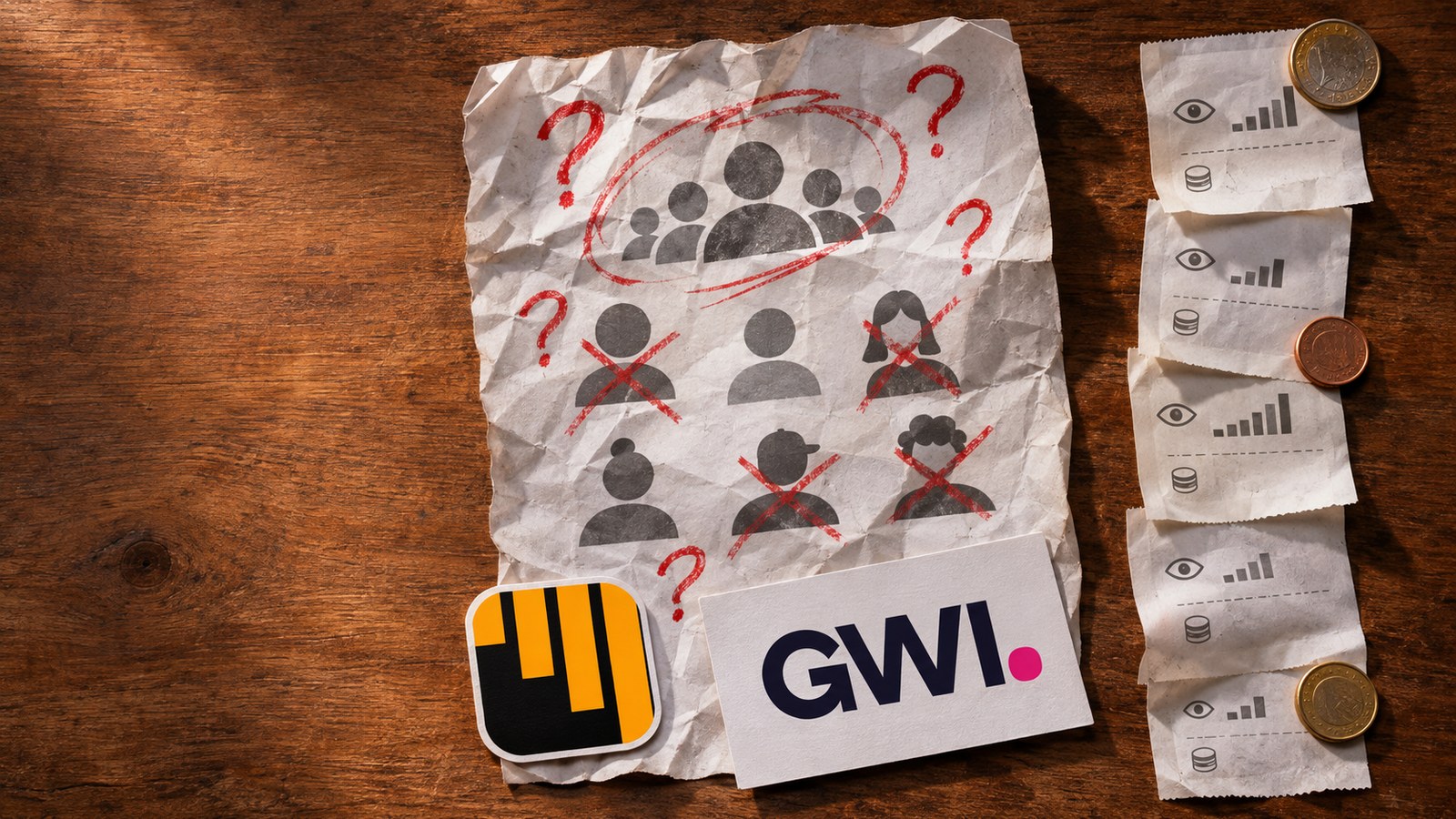
Not reliably. In a report published on 13 November 2026, GWI asked 1,883 senior insights, agency and marketing professionals in the U.K., the U.S. and Singapore about the AI tools they use every day: 80% said they frequently run into inaccurate or misleading AI findings, and 27% have already lost money because of one. That is the strongest argument yet for buying results instead of forecasts — Prime Oracles turns one piece of brand content into hundreds of short videos by independent creators, paid per view, so a pay-per-view brand campaign is billed against views that have already happened, not against a predicted audience.
Key takeaways
- 80% of the 1,883 professionals surveyed by GWI frequently see inaccurate or misleading AI findings; only 36% verify AI insights most of the time.
- 82% report at least one adverse outcome. Financial loss hit 27% of them, weaker campaign performance 21%.
- 58% have made a significant business decision on an AI insight that was later proved wrong or misleading.
- 63% accidentally used out-of-date insights, and 71% say AI tells them what happened but not why.
- A view that a platform has counted and a marketplace has verified is a past event, so it can be priced per 1,000 — on Prime Oracles the English-language board runs from $0.10 to $3 per 1,000 views.
What exactly did GWI measure?
The survey sits inside a report called "Artificial Confidence: The AI Trust Gap". GWI collected answers in the third quarter of 2026 from 1,883 senior insights, agency and marketing professionals working at companies with at least 500 employees or $26.5 million in annual turnover, across three markets: the U.K., the U.S. and Singapore.
The headline tension is in the title. Nearly 90% of those professionals use AI every day, 81% feel confident using it to build audience profiles, and 84% believe it explains human behaviour accurately. The same people then report error rates that would be unacceptable in any other input they pay for.
How often do AI audience insights go wrong?
Four numbers from the report describe the failure rate:
- 80% frequently encounter inaccurate or misleading AI findings.
- 70% have seen a tool fail to reflect their actual target audience, leaning on stereotypes instead of observed behaviour.
- 63% have accidentally used out-of-date insights, and 68% think colleagues are doing the same without noticing.
- 71% say AI reveals the "what" but not the "why", which is why 80% still want a human in the loop for motivation.
The part that turns this from a quality problem into a budget problem is verification. Only 36% of respondents check AI insights most of the time. The rest ship campaigns on an output nobody audited.
"Everyone using AI feels confident, yet simultaneously maintains strong concerns with remarkably high negative impact rates," said Jason Mander, GWI's chief insight officer.
What does a wrong audience insight cost?
GWI asked what actually happened after a bad insight. 58% said it had shaped a significant business decision. 82% reported at least one adverse outcome, broken down like this:
| Consequence | Share of respondents |
|---|---|
| Internal rework | 38% |
| Delayed decision-making | 36% |
| Customer complaints | 34% |
| Financial loss | 27% |
| Reputational damage | 26% |
| Weaker campaign performance | 21% |
Read the last two rows together and you get the media-buying version of the problem. Roughly one in four brands paid for a campaign that was aimed at an audience the model had invented.
Why does paying per verified view change the math?
An AI audience profile is a prediction about people who have not seen your ad yet. A view is a record of something that already occurred. The difference matters at the invoice.
On Prime Oracles a brand posts a task with a rate per 1,000 views and a budget. Independent creators pick it up themselves, publish on TikTok, Reels or Shorts, and the marketplace counts the views on those posts. Money leaves the budget only as verified views arrive — a campaign that reaches nobody spends nothing. You can open the live rates in Content rewards on Prime Oracles before you set your own.
This does not make targeting irrelevant. It moves the risk: if the audience guess was wrong, the clips simply do not travel, and you are not billed for the ones that never happened. Our breakdown of why 67% of marketers cannot measure creator campaigns covers the measurement side of the same gap.
What does a budget of $1,000 buy?
Rates on the English-language board today run from $0.10 per 1,000 views for clip tasks up to $3 per 1,000 for an original creator video. Same budget, different rate:
| Rate per 1,000 views | Views for $1,000 |
|---|---|
| $0.10 | 10,000,000 |
| $0.20 | 5,000,000 |
| $0.50 | 2,000,000 |
| $1 | 1,000,000 |
| $2 | 500,000 |
| $3 | 333,000 |
Live example from the board: the MEDUSA sound task pays $0.10 per 1,000 views and has paid out $2,602 of a $3,000 budget against 26,026,866 counted views. The Prime Oracles banner task pays $0.20 per 1,000, with a $1 minimum per video at 5,000 views and an $80 maximum. Across the whole marketplace there are now 51,743 creators, who together have earned $50,923, across 379.4 million views.
Nobody forecast those numbers. They were counted after the fact.
If you are a creator, what does this mean for you?
It means the task board is not screening you through an "AI audience profile" before you are allowed to earn. You do not pitch, you do not wait for a brand to decide whether you match an invented persona, and there is no follower threshold: you take a task from Content rewards, publish, and the rate per 1,000 views applies to whatever the clip actually does. On a $1 per 1,000 task, 100,000 views is worth $100. Payouts have a per-video minimum and maximum written on each card — on the banner task that is $1 at the bottom and $80 at the top.
What GWI has not published
The report gives the overall figures but not a per-market split, so there is no way to tell from it whether the U.K., the U.S. and Singapore differ. GWI also does not define "frequently" in the 80% figure, and the 27% financial-loss number comes with no sizing — a loss could be a reshoot or a quarter of media spend. Treat those as directional, according to GWI.
FAQ
Are AI audience insights accurate?
Often not. 80% of the senior professionals GWI surveyed frequently see inaccurate or misleading AI findings, and 70% have seen a tool misrepresent their actual target audience.
How many marketers check what the AI tells them?
36% verify AI insights most of the time. The majority do not.
Has anyone actually lost money over this?
Yes. 27% of respondents reported financial loss and 21% reported weaker campaign performance after acting on a bad AI insight.
What is the alternative to paying for predicted reach?
Pay per verified view. The campaign is billed only for views that platforms counted and the marketplace verified, so an unviewed campaign costs nothing.
How much does a pay-per-view campaign cost to start?
You set the rate and the budget yourself. Current English-language tasks on the board run $0.10 to $3 per 1,000 views, with live budgets from $500 to $5,000.
Do creators need a minimum follower count?
No. Tasks are open to anyone who can publish; payment follows the view count, not the follower count.
Start with a result, not a forecast
If 8 in 10 of your peers are catching their AI tools getting the audience wrong, the safest line item in the plan is the one that only charges you for what happened. Set a rate per 1,000 views, set a budget, and create a campaign on Prime Oracles — the money moves as the views land. If you are planning a launch without a single face in front of it, our write-up of how Djerf Avenue grew a brand without an ambassador shows what that looks like in practice.