
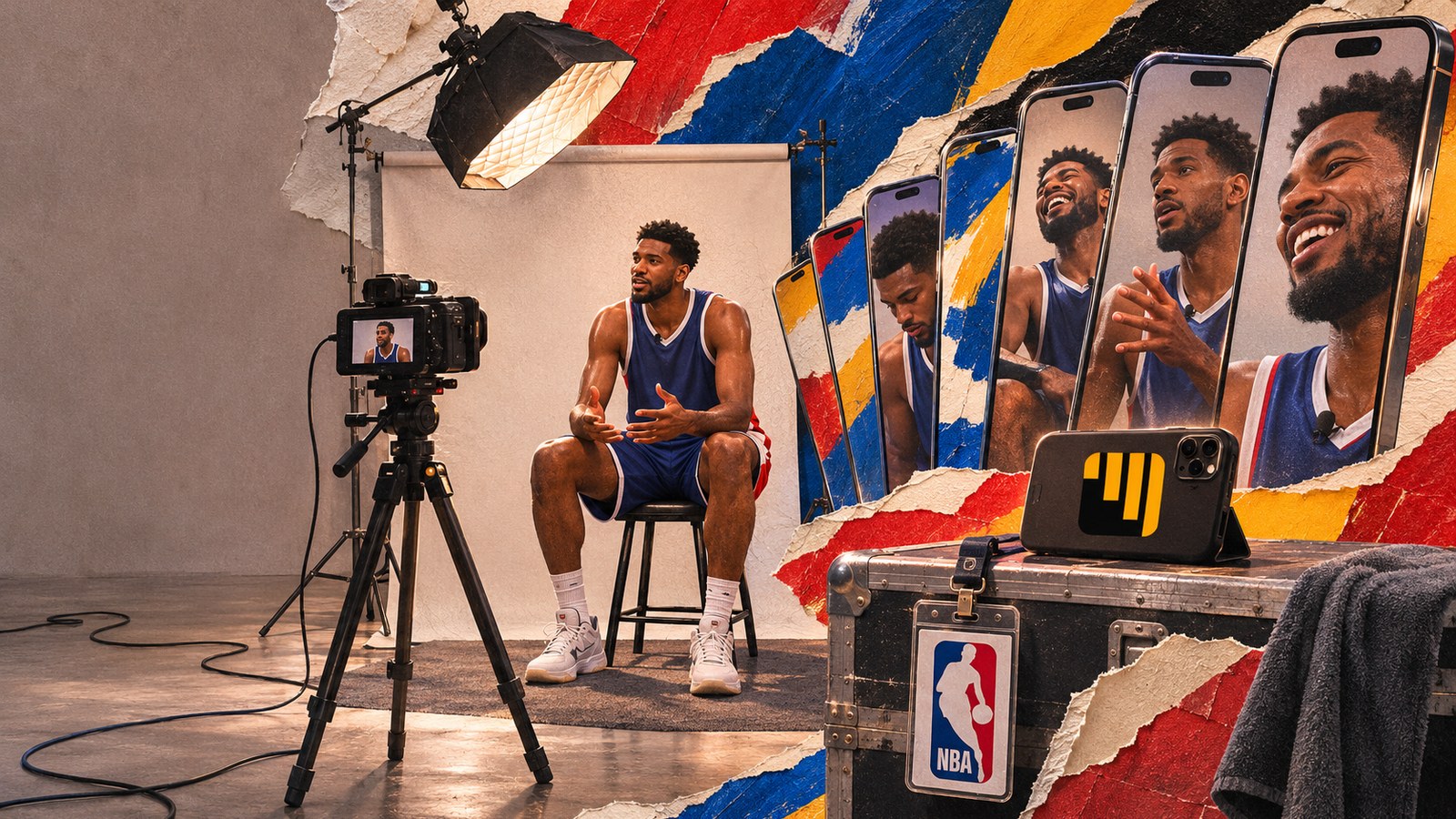
One morning of interviews can out-reach a televised game. On 13 November 2026 Net Influencer reported that NBA teams are opening media day to the creator-led outlet Enjoy Basketball: at the Washington Wizards, every starter spent 10–15 minutes with its hosts, and the social clips cut from that morning passed more than 10 million impressions in their first 24 hours. That is the same mechanic clippers are already paid for — on Prime Oracles, clippers get paid per 1,000 verified views for clips of brand and creator content, and you can pick up an interview task today in Content rewards on Prime Oracles.
Key takeaways
- Wizards media day clips from Enjoy Basketball passed 10 million impressions in the first 24 hours, according to Net Influencer.
- Every Wizards starter gave the hosts 10–15 minutes, so a single morning yields roughly an hour of raw interview footage.
- One hour of talking realistically carries about 20 publishable short clips of 30–60 seconds each.
- Co-founder Cody Hock on why: "getting the younger demographic to watch a two-and-a-half-hour game is just almost impossible at this point."
- On the English-language board, the School of Hard Knocks interview-clipping task paid $0.70 per 1,000 views and ran its full $1,500 budget against 2,140,852 counted views.
What actually happened at NBA media day?
Enjoy Basketball was co-founded in 2022 by brothers Cody and Cole Hock, with basketball creator Kenny Beecham at the centre of it. The first product was a newsletter; podcasts started in January 2024; YouTube is the main platform. Teams now hand the outlet the kind of access that used to go to broadcast press — the Wizards gave every starter 10–15 minutes, Miami Heat media day has been covered for two or three seasons, and the Sacramento Kings invited the team recently.
The reason is the audience, not the credential. "A lot of the time it's just highlights and clips rather than sitting down and watching a full game," says Cole Hock. The outlet has worked with the NBA, ESPN, NBC, Bleacher Report / House of Highlights and Omaha Productions, and its NBA partnership is expanding this season.
Which sources produce clips with the most reach?
Three formats keep showing up at the top, and all three share one trait: somebody talks, unscripted, for a long time.
- Interviews and press access — media day, locker-room access, post-event scrums. Short answers, emotion, a name people search.
- Podcasts — one episode is 60–120 minutes of material with natural chapter breaks.
- Streams and long-form YouTube — reactions and unplanned moments, already shot in a format you can crop.
What none of them need is a shoot of your own. The footage exists; the scarce part is cutting it.
How do you get 20 clips out of one hour?
An hour of interview contains roughly 10–20 minutes of material worth posting. At 30–60 seconds per clip that is about 20 pieces. A workable pass:
- Watch once at normal speed and timestamp every moment that would make a stranger stop scrolling: a number, a disagreement, a confession, a joke.
- Keep one idea per clip. Two ideas means two clips, not a longer one.
- Put the payoff in the first two seconds, then the context. Reversed order is why most interview clips die.
- Crop vertical on the speaker's face, burn in captions — most of these are watched muted.
- Publish across TikTok, Reels and Shorts. The same cut earns separately on each platform where the task allows it.
Everything starts with the long file — as Cody Hock puts it, "Everything starts on YouTube. That's first. That's our biggest platform." The clips go outward from there.
What do 20 clips actually pay?
Say those 20 clips average 25,000 views each: 500,000 views in total. What that is worth depends only on the rate on the task card.
| Rate per 1,000 views | Payout for 500,000 views |
|---|---|
| $0.10 | $50 |
| $0.40 | $200 |
| $0.70 | $350 |
| $1 | $500 |
| $2 | $1,000 |
Live examples from the English-language board: School of Hard Knocks paid $0.70 per 1,000 views for clipping its interviews and spent its whole $1,500 budget against 2,140,852 views, with a $1 minimum and a $200 maximum per video. The JGGL task pays $1 per 1,000 views for clipping official brand content and has paid $216 of $500 so far. Across the marketplace there are now 51,746 creators, who together have earned $50,926, across 379.4 million counted views.
If you run a club, a brand or a podcast
Enjoy Basketball is the cheap version of a media department: the team talks for an hour, somebody else does the cutting, and the reach lands in feeds the club does not own. You can buy the same outcome directly. Post the raw footage as a clipping task, set a rate per 1,000 views and a budget, and independent creators cut and publish it — you pay for views that have already been counted, not for a production day. Our guide to what a clipping campaign costs has the full breakdown, or you can create a campaign on Prime Oracles straight away.
FAQ
How many clips can you get from one hour of interview?
About 20 at 30–60 seconds each, if you only keep moments that stand on their own. An hour of talking rarely holds more than 10–20 minutes of postable material.
Do I need permission to clip someone's interview?
Yes — that is what a clipping task is for. The rights holder posts the footage and the rules on the card, so the clips you publish are licensed by default.
How much do clippers earn per 1,000 views?
It depends on the task. English-language clip tasks currently run from $0.10 to $1 per 1,000 views, with a minimum and a maximum payout per video printed on each card.
Do I need followers to take a clipping task?
No. Payment follows the view count, not the follower count, and there is no subscriber threshold to start.
Why do clips beat the full broadcast?
Because of how younger fans watch. Cody Hock: a two-and-a-half-hour game is "almost impossible" for that demographic, while a 10-minute breakdown or a 60-second recap fits.
Where do I find footage I'm allowed to clip?
On the Content rewards board — each clip task links the source material the brand or creator wants cut.
Start with footage somebody already shot
A media day is one morning of work that turned into millions of impressions because the cutting was done by people who get paid per view. You do not need NBA access to do the same thing: open the clip tasks in Content rewards, take one with footage you can work with, and publish. If you want the numbers on how far clips travel against the original broadcast, see how SNL's clips hit 424M views against 5.6M on TV. Before you submit, run through the eight reasons clips get rejected.