
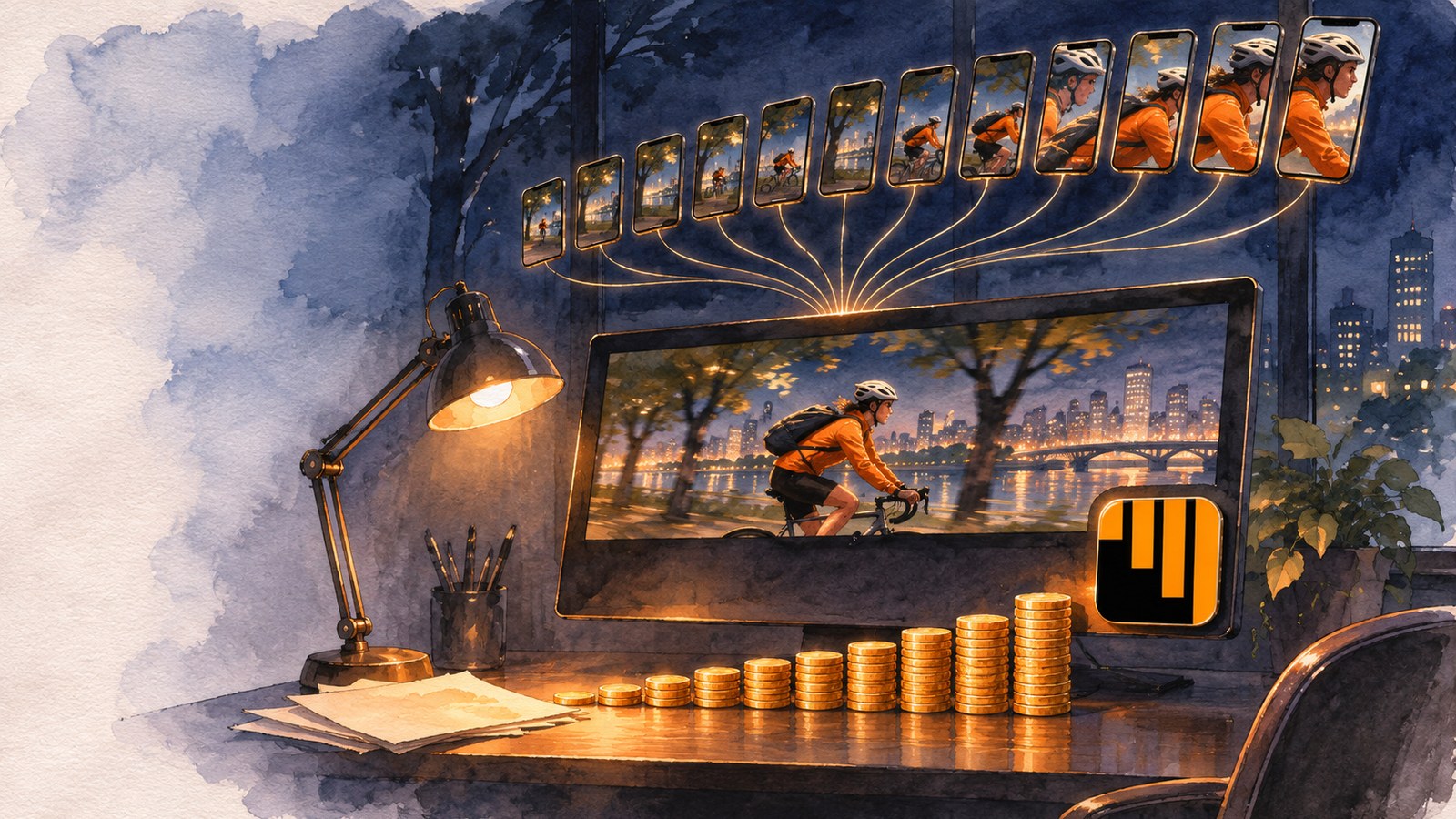
A clipping campaign is an open task with a funded budget: you upload your footage, set a price per 1,000 views, and independent editors cut clips from it and post them on their own accounts. On Prime Oracles, clippers get paid per 1,000 verified views for clips of brand and creator content, so the arithmetic is simple — a million views at $1 per 1,000 costs about $1,000, and a clip that nobody watches costs you nothing. Create a clipping campaign on Prime Oracles and the price you set is the price you pay.
Key takeaways
- A campaign has three price settings: the rate per 1,000 views, the minimum payout per video and the maximum payout per video.
- At $0.50 per 1,000 views, a reach of 100,000 views costs $50. At $1 the same reach costs $100, and at $2 it costs $200.
- Four campaigns on the Prime Oracles showcase that spent their budgets in full paid $5,736 in total for 17.1 million views — an average of about $0.34 per 1,000.
- On every one of those campaigns, money paid divided by views delivered matched the posted rate almost to the cent: there is no second price hidden behind the first.
- A test campaign starts at $250, and the unspent part of a budget is refunded in full.
- Cheap is not automatically slow and expensive is not automatically fast: what decides pickup is how much one clip can earn an editor, not the headline rate.
What is a clipping campaign on Prime Oracles?
You already own content that runs long: episodes, streams, interviews, game sessions, product footage, a music track. A clipping campaign turns that archive into short vertical videos made by other people and pays those people per 1,000 verified views of what they publish.
In practice a campaign is one card in the Content rewards feed. The card carries your brief, your source materials, your rate and your payout limits. Editors browse the feed, take the task, publish clips on TikTok, YouTube Shorts and Instagram Reels from their own accounts, then submit the link for review. Verified views turn into payouts out of your budget until the budget runs out or the campaign's end date arrives.
Prime Oracles sits in the middle as the marketplace: it holds the budget in escrow, checks submissions and pays creators. It does not film, does not edit and does not assign a roster of creators to you.
How is this different from paying one creator for a post?
| Sponsored post from one creator | Clipping campaign | |
|---|---|---|
| What you buy | one publication | verified views, however many clips they take |
| When you pay | before the post goes live | after views are counted and checked |
| If it flops | you paid anyway | you pay almost nothing |
| If it travels | one hit, one account | every clip that travels keeps earning you reach |
| Volume | one video | dozens of videos from different accounts |
| Price you control | negotiated per deal | one rate per 1,000 views for everybody |
The practical consequence: your downside is bounded by the budget, your upside is not bounded by one creator's audience. The trade is control — you choose the rules and the footage, but you do not choose who takes the task.
How the rate, the minimum and the maximum work
Three numbers on the card do the pricing.
The rate per 1,000 views is your CPM. It is what you pay for every thousand views a clip earns, once those views pass verification.
The minimum payout per video is the floor a clip has to reach before it bills you at all. On the School of Hard Knocks interview campaign the rate was $0.70 per 1,000 views with a $1 minimum, which is roughly 1,430 views. Clips below that line cost nothing.
The maximum payout per video is the ceiling. The same campaign capped a single clip at $200, which it reaches at about 285,700 views. Everything a clip collects above the cap is reach you do not pay for — and it is also the setting that stops one suspicious video from draining a budget.
Live examples from the Prime Oracles showcase on 14 November 2026: an anime and TV edits campaign runs at $0.10 per 1,000 views with limits from $1 to $200 per video; a UGC task about the platform itself runs at $2 per 1,000 with limits from $2 to $300; an app review task runs at $3 per 1,000 with limits from $6 to $300.
What do 100,000 and 1,000,000 views cost?
Multiply thousands of views by your rate. That is the whole formula.
| Views | At $0.50 per 1,000 | At $1 per 1,000 | At $2 per 1,000 |
|---|---|---|---|
| 100,000 views | $50 | $100 | $200 |
| 500,000 views | $250 | $500 | $1,000 |
| 1,000,000 views | $500 | $1,000 | $2,000 |
| 5,000,000 views | $2,500 | $5,000 | $10,000 |
Read the same table from the budget side — this is the one brands actually plan with:
| Budget | At $0.50 per 1,000 | At $1 per 1,000 | At $2 per 1,000 |
|---|---|---|---|
| $250 | 500,000 views | 250,000 views | 125,000 views |
| $500 | 1,000,000 views | 500,000 views | 250,000 views |
| $1,000 | 2,000,000 views | 1,000,000 views | 500,000 views |
| $5,000 | 10,000,000 views | 5,000,000 views | 2,500,000 views |
Two lines sit outside that grid. First, the platform reserves a 15% campaign commission on the budget, earned only on the amounts actually paid to creators, while top-ups, launching and refunds carry no fee. Second, your own time: you are not producing clips, but somebody has to collect the source files and write a brief people can execute.
How many videos is that? The payout cap sets the floor. With a $100 maximum per video, a $1,000 budget cannot be spent by fewer than ten clips; with a $200 cap, by fewer than five. In practice campaigns of this size are spread across dozens of accounts, because most clips land far below the cap.
What budgets actually bought on the showcase
These are finished and running campaigns as the cards showed them on 14 November 2026, with the last column calculated as money paid divided by views delivered.
| Campaign | Rate per 1,000 | Paid of budget | Views | Real cost per 1,000 |
|---|---|---|---|---|
| Film to a TikTok sound (Xamid) | $0.15 | $1,499 of $1,500 | 9,993,333 | $0.15 |
| React to a track (High Forever) | $0.40 | $995 of $1,000 | 2,487,525 | $0.40 |
| Sound promotion (I AM) | $0.70 | $1,749 of $1,749 | 2,498,571 | $0.70 |
| Clip the interviews (School of Hard Knocks) | $0.70 | $1,493 of $1,500 | 2,140,852 | $0.70 |
| Anime and TV edits (Zak Azoury — MEDUSA) | $0.10 | $2,514 of $3,000 | 25,149,235 | $0.10 |
The useful part is the last column. On a pay-per-view marketplace the advertised rate and the realised rate are the same number, because you are billed on counted views rather than on a media plan. What varies is not the price of a view — it is how many views your footage can produce for the money.
Across the whole platform the public counters on 14 November 2026 showed 49,940 creators, who together have earned $50,212, and 370.8 million views delivered.
Why do campaigns under $0.50 per 1,000 often stall?
Because an editor reads your rate as an hourly wage. Here is what one clip pays its author:
| Clip reaches | At $0.10 per 1,000 | At $0.50 per 1,000 | At $1 per 1,000 | At $2 per 1,000 |
|---|---|---|---|---|
| 10,000 views | $1 | $5 | $10 | $20 |
| 50,000 views | $5 | $25 | $50 | $100 |
| 200,000 views | $20 | $100 | $200 | $400 |
An hour of editing for a couple of dollars is not a deal, so a cheap campaign only works when the footage carries itself to six figures of views on its own. The showcase shows both outcomes at the same price point: the anime and TV edits campaign at $0.10 per 1,000 has spent 84% of a $3,000 budget and collected 25.1 million views, because that source material travels. Another $0.10 campaign, built around edits about money and clipping, still shows zero views on its card. On the same day a gaming clip task priced at $0.45 per 1,000 and a banner task priced at $0.11 per 1,000 also showed zero views on the platform's front page.
So the honest rule is not "pay more than $0.50". It is: multiply your rate by the number of views one clip from your footage can realistically get. If that product is under roughly $5 to $10 per clip, raise the rate, raise the cap, or give editors better material. Below that, your campaign competes for the same editors as everything else in the feed — and loses.
How are views verified, and what counts as inflation?
This is the question that decides whether pay-per-view is a bargain or a leak, and the platform publishes its checks.
Every submission goes through manual moderation — not a sample, every one. View geography is requested from each video's statistics, because platform APIs do not expose it, and views outside your target region are not paid for. The engagement-to-views ratio is checked on the simple logic that 20,000 views with ten likes is not organic. The shape of the view curve matters too: sharp spikes with flat retention point to bought traffic. And when a narrow group of linked accounts applies for one task, the cluster is reviewed by hand. Prime Oracles says the anti-fraud system behind this was built on more than 10,000 analysed videos, over 70,000 unique behaviour metrics and a calibration set of 33,000 posts. Budgets sit in escrow until a result is confirmed, and one video can be submitted for payout only once.
Your own levers are on the card: the minimum payout keeps dead clips off your invoice, the maximum payout caps any single video, the audience filter limits who the task is shown to, and the live paid-out counter lets you watch the burn rate daily instead of reading a report a month later.
How to launch a campaign step by step
- Open Create campaign and choose the format: clip (editors cut your footage), banner (your banner inside someone else's video) or UGC (creators film original videos about your product).
- Pick the category and the audience — English-speaking or Russian-speaking creators.
- Set the rate per 1,000 views, then the minimum and maximum payout per video.
- Fund the budget. A test campaign starts at $250 and the unspent part comes back in full, so the first run is a measurement, not a bet.
- Set the dates with margin: the campaign stops when the budget runs out or the end date arrives, whichever comes first.
- Write the brief in two or three plain sentences — what the content is and which moments you want.
- Write the requirements: minimum length, vertical 9:16, captions, where links and mentions go, no view inflation, and how long the clip must stay up after payout.
- Attach the materials: the actual folder or channel with footage editors are allowed to use.
- Publish. The card appears in the Content rewards feed, creators take it, and you pay out of escrow as verified views land.
What you get, and what you do not
You get volume from accounts that are not yours, a price per 1,000 views that you set, and a bill that follows results. You do not get a delivery date, an exclusive creator, or a guarantee that anybody takes the task at all. Nothing forces an editor to pick your campaign over the one above it in the feed — the rate, the cap and the quality of your source files are the whole of your argument.
If you are a creator, not a brand
The other side of this page is a paid task. Clip campaigns on Prime Oracles pay per 1,000 verified views with no follower threshold to clear first: browse open clip tasks, check the rate and both payout limits before you spend an evening editing, and post from your own account.
FAQ
What is a clipping campaign?
A funded open task: a brand uploads footage and pays independent editors per 1,000 verified views of the clips they publish from it. Nobody is hired, and nothing is paid upfront to any individual creator.
What does CPM mean in clipping?
Cost per 1,000 views. In a clipping campaign you set it yourself — $0.50, $1, $2 — and you are billed on views that pass verification, so the rate you post is the rate you pay.
How much does a clipping campaign cost?
As much as the views you buy. A million views costs about $500 at $0.50 per 1,000, about $1,000 at $1 and about $2,000 at $2. Finished campaigns on the Prime Oracles showcase averaged roughly $0.34 per 1,000 views.
What is the minimum budget?
A test campaign starts at $250, and whatever the campaign does not spend is refunded in full.
Do I pay for fake views?
No. Every submission is moderated by hand, inflated views are not paid for, views outside the target region are excluded, and the budget stays in escrow until the result is confirmed.
How many clips will my campaign get?
That is the part nobody can promise. It follows from your rate, your payout cap and how watchable your footage is — the table above shows what one clip earns at each rate, and that is the number editors are doing in their heads.
Start with one measurement
Take the footage you already have, set a rate you would be happy to pay for a thousand views, cap the payout per video, and fund $250 to $500 for the first run. Launch a clipping campaign on Prime Oracles, then judge it after two weeks on one number: cost per 1,000 verified views.
For the mechanics of payouts and checks from the creator side, see how Prime Oracles payouts and view verification work. If your source material is a podcast or an interview show, the step-by-step version for that format is in how to run a pay-per-view clipping campaign for a podcast.
Figures in this article: Prime Oracles campaign cards and home-page counters as read on 14 November 2026, and the platform's About page on fees, anti-fraud and the test-campaign minimum.