
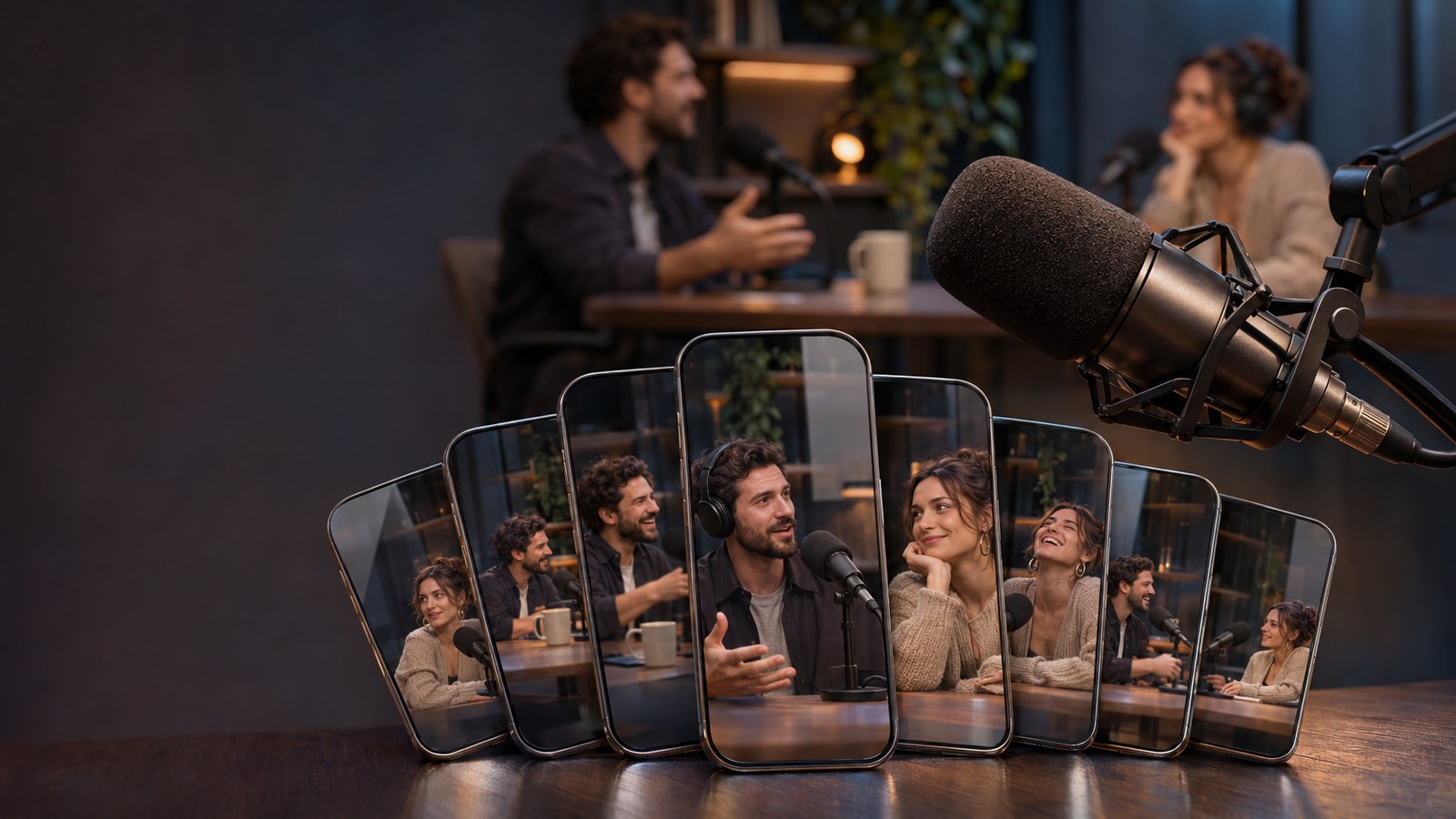
A pay-per-view clipping campaign costs exactly what its views cost: at the median podcast rate of $1.38 per 1,000 views, a million views of clips from your episodes runs about $1,380, and you pay as the views land instead of paying upfront for a placement. On Prime Oracles, clippers get paid per 1,000 verified views for clips of brand and creator content, so your job is to fund a budget, set the rate and write the brief — launch a podcast clipping campaign on Prime Oracles and independent editors take it from there.
Key takeaways
- Across 32 live podcast clipping campaigns tracked by Clipping Alpha on 9 November 2026, rates run from $0.40 to $3.00 per 1,000 views, median $1.38.
- You are buying views, not posts: a clip that gets no traction costs you nothing.
- Two payment models exist — a flat rate per 1,000 views, or threshold payouts per video (one real podcast campaign paid $3 at 10,000 views and capped at $50 per clip).
- Money moves faster than most brands expect: podcast campaign budgets last a median 11 days, and one interview campaign on Prime Oracles spent $1,493 of a $1,500 budget in under two weeks.
- Your budget is a ceiling, not an invoice: across 719 live campaigns on a competing marketplace, only 48% of funded budgets had actually been spent, and Prime Oracles refunds an unspent campaign balance in full with no fee.
- A test campaign on Prime Oracles starts at $250, and every submission goes through manual moderation before it is paid.
What is a pay-per-view clipping campaign?
You own long content — podcast episodes, streams, interviews, webinars. A clipping campaign turns that archive into short vertical videos made by other people, and pays them for the views those videos earn.
The difference from everything else you have bought:
- Paid ads: you pay for impressions a platform sells you, and stop the moment the budget ends.
- A sponsored post from one creator: you pay a fixed fee whether the post does 3,000 views or 300,000.
- An agency retainer: you pay monthly for production and management, usually before any view exists.
- A clipping campaign: dozens of editors post clips on their own accounts, and you pay per 1,000 verified views of what they publish. Prime Oracles turns one piece of brand content into hundreds of short videos by independent creators, paid per view.
The practical consequence is that your downside is bounded and your upside is not. If 40 clips flop and 3 travel, you pay mostly for the 3 that travelled.
How much does a clipping campaign cost in 2026?
Three honest reference points, all dated:
- Podcast niche, 9 November 2026: 32 live podcast clipping campaigns, median $1.38 per 1,000 views, range $0.40 to $3.00, with $83,801 of budget still unspent across them (Clipping Alpha).
- Whole market, 17 October 2026: Clipping Collective analysed 719 live campaigns on Whop's Content Rewards marketplace — median advertised rate $1.00 per 1,000 views, middle 50% between $1.00 and $2.00, median campaign budget $1,468. Dividing money actually spent by views actually delivered, the real cost came out at $0.52 per 1,000 views, and $0.67 for pure clipping work.
- Prime Oracles showcase, 8–9 November 2026: live clip campaigns are priced from $0.10 per 1,000 views for anime and TV edits to $1.25 for sports highlights, with interview and podcast work sitting between $0.30 and $0.70.
Advertised rates are higher than real costs for one boring reason: a lot of clips never reach the payout threshold, so those views are free. Across every campaign type on Prime Oracles to date, the public counters on the home page show $45,455 paid to creators against 353.4 million views — roughly $0.13 per 1,000 views on average, because cheap banner tasks pull that average down.
Budget math: what 1 million views actually costs
Pick your rate, multiply by thousands of views, and that is your creator payout line:
- 250,000 views at $0.40 per 1,000 — $100
- 250,000 views at $1.38 per 1,000 — $345
- 250,000 views at $3.00 per 1,000 — $750
- 1,000,000 views at $0.40 per 1,000 — $400
- 1,000,000 views at $1.38 per 1,000 — $1,380
- 1,000,000 views at $3.00 per 1,000 — $3,000
- 5,000,000 views at $1.38 per 1,000 — $6,900
Two lines to add to that:
- The platform fee. Prime Oracles reserves a 15% campaign commission from the budget and, in its own words, earns it "only on amounts paid to creators", with the unspent part refunded in full; topping up, launching and refunding carry no fee. Content Rewards, the biggest competitor, publishes 10% (8% for verified organisations), also charged only on approved work, and its campaigns start at $1,000.
- Your own editing time. You are not producing the clips, but someone has to collect source files, write the brief and approve the odd borderline clip.
A realistic first podcast campaign: $500 at $0.50 per 1,000 views buys about a million views if the budget runs out, and nothing at all if your brief is unworkable. Prime Oracles sets the entry at a test campaign from $250 with the remaining budget withdrawable without a fee, and its live showcase has campaigns funded at $168, $199 and $201 — so there is no four-figure entry ticket.
Rate per 1,000 views, or thresholds per clip?
Prime Oracles campaign cards show the payment model up front, and there are two.
A rate per 1,000 views is simple and favours big clips: the School of Hard Knocks interview campaign paid $0.70 per 1,000 views, with a minimum payout of $1 per video (about 2,000 views) and a maximum of $200.
Threshold payouts pay a fixed sum for the highest view mark a clip reaches. The finished podcast campaign from Фаундер (Founder), a Russian-language business interview channel, used this ladder:
| Clip reaches | Payout | Your cost per 1,000 views |
|---|---|---|
| 10,000 views | $3 | $0.30 |
| 50,000 views | $15 | $0.30 |
| 100,000 views | $35 | $0.35 |
| 250,000 views or more | $50 (max) | $0.20 or less |
Read the right-hand column twice before you choose. With thresholds, a clip at 9,000 views costs you nothing, a clip at 49,000 views still costs $3, and a clip at 2 million views costs $50 — your worst case is about $0.35 per 1,000 views, and runaway hits are nearly free. With a flat rate, you pay for every verified view, which is exactly what you want if your goal is reach rather than a fixed cost per clip.
What to put in the brief
A Prime Oracles campaign card has a fixed set of fields, and each one is a decision you make:
- Type: clip, banner or UGC. Podcast and stream archives are clip work.
- Category and audience: business, gaming, music, personal brand; English-speaking or Russian-speaking creators.
- Platforms: TikTok, Instagram, YouTube — pick all three unless you have a reason not to.
- Rate per 1,000 views or the threshold ladder, plus minimum and maximum payout per video.
- Start and end dates.
- What you do: two or three sentences in plain language about the content and the moments you want.
- Requirements: the hard rules.
- Materials for creators: the actual source files.
The requirements block from two real campaigns, as written on the cards:
- source footage only from the official materials folder;
- the full episode must be named in the description;
- video at least 20 seconds long, vertical 9:16;
- captions on screen throughout;
- do not change the meaning of what people say;
- no view inflation;
- do not delete the video for 20 days after payout.
That last one matters more than it looks: without it you pay for views and then watch the clip disappear.
How views are verified, and how not to pay for bots
This is the question that stops most podcast owners, and it has two answers: what the platform checks, and what you set yourself.
Prime Oracles publishes the checks it runs before a payout: manual moderation of every submission, not a sample; view geography pulled from each video's statistics, because platform APIs do not expose it and views outside the target region are not paid for; the engagement-to-views ratio, on the logic that "20,000 views with ten likes is not organic"; the shape of the view curve, where sharp spikes and flat retention point to bought traffic; and creator concentration, so a cluster of linked accounts applying for one task gets reviewed by hand. The company says the system behind this was calibrated on 33,000 posts and more than 10,000 analysed videos. Campaign money sits in escrow until the result is confirmed, and inflated views, per the same page, are never paid for.
Your own levers are on the campaign card:
- Minimum payout per video. At $1 per video (about 2,000 views at $0.70 per 1,000), clips that never get traction never bill you.
- Maximum payout per video. A $50 or $200 cap means one suspicious clip cannot drain the budget, however far its counter runs.
- Payment after views, not after posting. The card shows paid-out and remaining amounts live, so you can watch the burn rate daily instead of reading a report a month later.
- An explicit no-inflation line in the requirements, so a rejected clip has a written reason behind it.
For context on why any of this is needed: TikTok reported removing 781 million fake accounts in a single quarter. Caps, geography checks and manual review beat trust.
How long until clips appear?
Faster than an agency brief cycle, and the data is consistent on this:
- Podcast campaign budgets that ended in the last 90 days lasted a median 11 days across 27 campaigns (Clipping Alpha, 9 November 2026).
- School of Hard Knocks launched an interview-clipping campaign on 22 October 2026 at $0.70 per 1,000 views. On 23 October the card showed $0 paid out. By 4 November it showed $1,493 of the $1,500 budget paid — roughly 2.1 million views of clips in under two weeks.
- The Founder podcast campaign went the other way: it opened on 11 August 2026, still had $323 of its $500 unspent on 10 October, and only finished the budget by 1 November. A narrow brief and a single source channel slow everything down.
One scheduling trap: campaigns close on their end date even when the budget has not been spent. If you set two weeks and the clips are still coming, extend the dates rather than refunding yourself.
Five mistakes that waste a clipping budget
- A brief so narrow that nobody can execute it. "Clip the best moments" plus a materials folder beats a ten-point style guide.
- No source files. If creators have to hunt for your episodes, your campaign loses to the one next to it that attached a folder.
- A rate under the floor. Below about $0.40 per 1,000 views you are bidding under every one of the 32 live podcast campaigns counted this week, for the same editors.
- Caps left at defaults. Minimum payout per video that is too high kills small clips; a maximum that is too low kills the incentive to chase a hit.
- Judging the campaign on day three. First clips arrive in days, but the budget curve usually bends upward in the second half.
If you are a creator, not a brand
The other side of this page is a job. Clip campaigns on the Prime Oracles showcase pay per 1,000 verified views, with no follower threshold to clear first: browse open clip tasks, check the rate and the payout caps, take one, and post from your own account. The business-podcast clipping task we broke down earlier is the same campaign analysed above, seen from the editor's side, and what 26 creator economy experts say about clipping for brands covers where this model is heading.
FAQ
How much does it cost to get my podcast clipped?
Budget by views, not by clip. At the November 2026 podcast median of $1.38 per 1,000 views, 500,000 views costs about $690; at the $0.40 floor, the same reach costs $200. Add the platform fee on top.
Do I pay per clip or per view?
Either. A rate per 1,000 views pays for every verified view; a threshold ladder pays a fixed amount per clip at 10,000, 50,000, 100,000 and 250,000 views. Thresholds cap your cost per clip, flat rates buy maximum reach.
What is the minimum budget for a clipping campaign?
Prime Oracles starts test campaigns at $250 and refunds the unspent balance with no fee; live campaigns on its showcase are funded from $168. The main competitor sets a $1,000 minimum, which is a steeper price for finding out whether your content clips well.
Who actually makes the clips?
Independent editors and clippers who choose your task from the showcase. You supply episodes and rules; they handle editing, posting and their own audience. Prime Oracles is the marketplace in the middle: it does not film, edit or assign creators to you.
Can I use episodes that are already published?
Yes — that is the normal case. Put the YouTube channel or a file folder in the materials block and require that clips come only from there.
How do I stop paying for inflated views?
Set a maximum payout per video, keep a minimum payout that excludes dead clips, write a no-inflation rule into the requirements, and watch the paid-out counter on your card daily rather than monthly. On the platform side, every submission is moderated by hand before payout, and views outside your target region are not paid for at all.
How fast will clips be live?
Days. Median podcast budget lifespan is 11 days, and the fastest campaign we tracked moved $1,493 in under two weeks.
Start with one episode
Pick the episode with your best three minutes, drop the file in a folder, set a rate and a cap, and fund $250 to $500 for the first run. Create a clipping campaign on Prime Oracles, and judge it on cost per 1,000 verified views after two weeks — not on how any single clip performed. The platform assigns a manager to the first campaign, so the brief, the rate and the moderation rules get set with someone who has seen what works.
If the creators you want to reach ask first whether the platform actually pays, point them at our walkthrough of how Prime Oracles payouts and view verification work — it covers the rates, the review windows and the withdrawal minimum from the creator side.
Figures in this article: Prime Oracles campaign cards, the platform's About page and its home-page counters as read on 8–9 November 2026; Clipping Alpha podcast tracker, 9 November 2026; Clipping Collective analysis of 719 live Content Rewards campaigns, 17 October 2026; Content Rewards pricing page.