
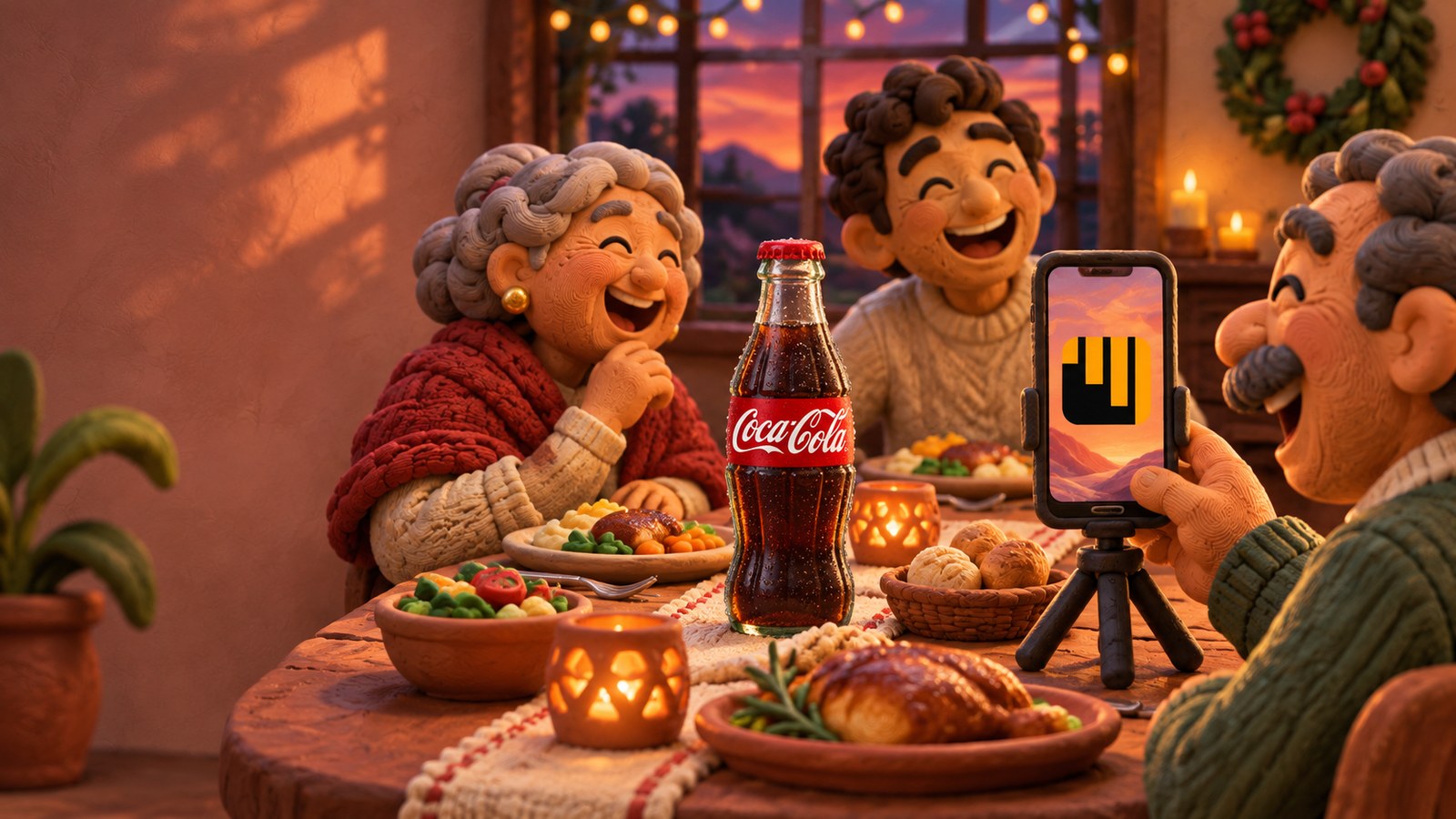
Coca-Cola filmed its new holiday campaign "Enjoy Joy" with real people, ending two years of generative-AI Christmas spots, and put the social half of the push on creator videos across Meta, TikTok, Pinterest and YouTube. Short video already prices that trade by the view: on Prime Oracles, brands pay UGC creators per view instead of per video — today from $1 to $3 per 1,000 verified views on open UGC tasks.
Key takeaways
- Marketing Dive reported on 19 November 2026 that the "Enjoy Joy" spots — 30, 15 and 6 seconds long — show people at the table and in the backyard, with no AI-generated imagery.
- The two previous holiday films were AI-made and, according to Marketing Dive, exceeded internal benchmarks anyway.
- CARMA measured the public side of last year's AI film: after launch the positive share of online conversations was 10.2% and the negative share 32%, against 23.8% positive and 31.4% negative before it.
Why did Coca-Cola drop AI from its holiday ad?
Not because the media numbers failed — Marketing Dive notes the AI films exceeded internal benchmarks. What they lost was the room, and CARMA's count is the clearest published figure: positive mentions slid to 10.2% while negative ones stayed at 32%.
Effort was not the issue either. A behind-the-scenes video reported by Today in November 2025 said five specialists generated and refined over 70,000 video clips in 30 days for that film. A month of machine output still bought a divided audience. With revenue of $13.4 billion in the third quarter of 2026, up 7%, this is a credibility decision rather than a cost cut — and the campaign now leans on a "Grandma's Holiday Table" creator series and an Amazon deal that ties creator content to buying.
Is it cheaper to generate a video or pay creators per view?
A generated film is a fixed cost: you pay for the asset, pay again to distribute it, and carry the risk if people dislike it. A per-view task is a variable cost — the budget drains only as verified views land, and a clip that flops costs nothing. Here is what a budget buys at the rates on the Prime Oracles English-language board today:
| Rate per 1,000 views | $500 budget | $3,000 budget |
|---|---|---|
| $1 | 500,000 views | 3,000,000 views |
| $2 | 250,000 views | 1,500,000 views |
| $3 | 166,000 views | 1,000,000 views |
A live example: "Inspoy — film your own AI stylist video" pays $3 per 1,000 views and has paid out $189 of its $3,000 budget so far, against 94,500 views. The rest is still unspent. You can launch a per-view campaign and set your own rate, minimum and maximum per video.
If you make videos, what can you film this week?
The same shift is already on the board: "Prime Oracles — Get Paid Per View" pays $2 per 1,000 views, "Inspoy" pays $3 per 1,000 with a floor of $6 and a ceiling of $300 per video, "JGGL — Make a Video About the App" pays $2 per 1,000. The platform has 54,404 creators, who together have earned $53,345 on 394.8 M views. No follower threshold: press "Claim task", film, post, get paid per 1,000 verified views.
FAQ
Did Coca-Cola say it will never use AI again?
No. The announcement covers this season's creative only, and the brand has not published an AI policy for next year.
Why pay per view instead of per video?
Because the view is the thing being bought. Money follows performance, and unused budget stays unused instead of being sunk into one file.
Can I use AI tools in a UGC task?
Read the card. It states what the video must show and which platforms count; if a brand wants real filmed footage, the card says so.
What to do with this
Selling something? The cheap version of Coca-Cola's pivot is a per-view task: create a campaign. Making videos? Open Content Rewards and claim a UGC task for a brand that wants a human in the frame.
More on this: UGC ads vs traditional ads: Crocs' $8.88M of $10.14M and Do brands still want AI video? Clay ads hit 188M views.