
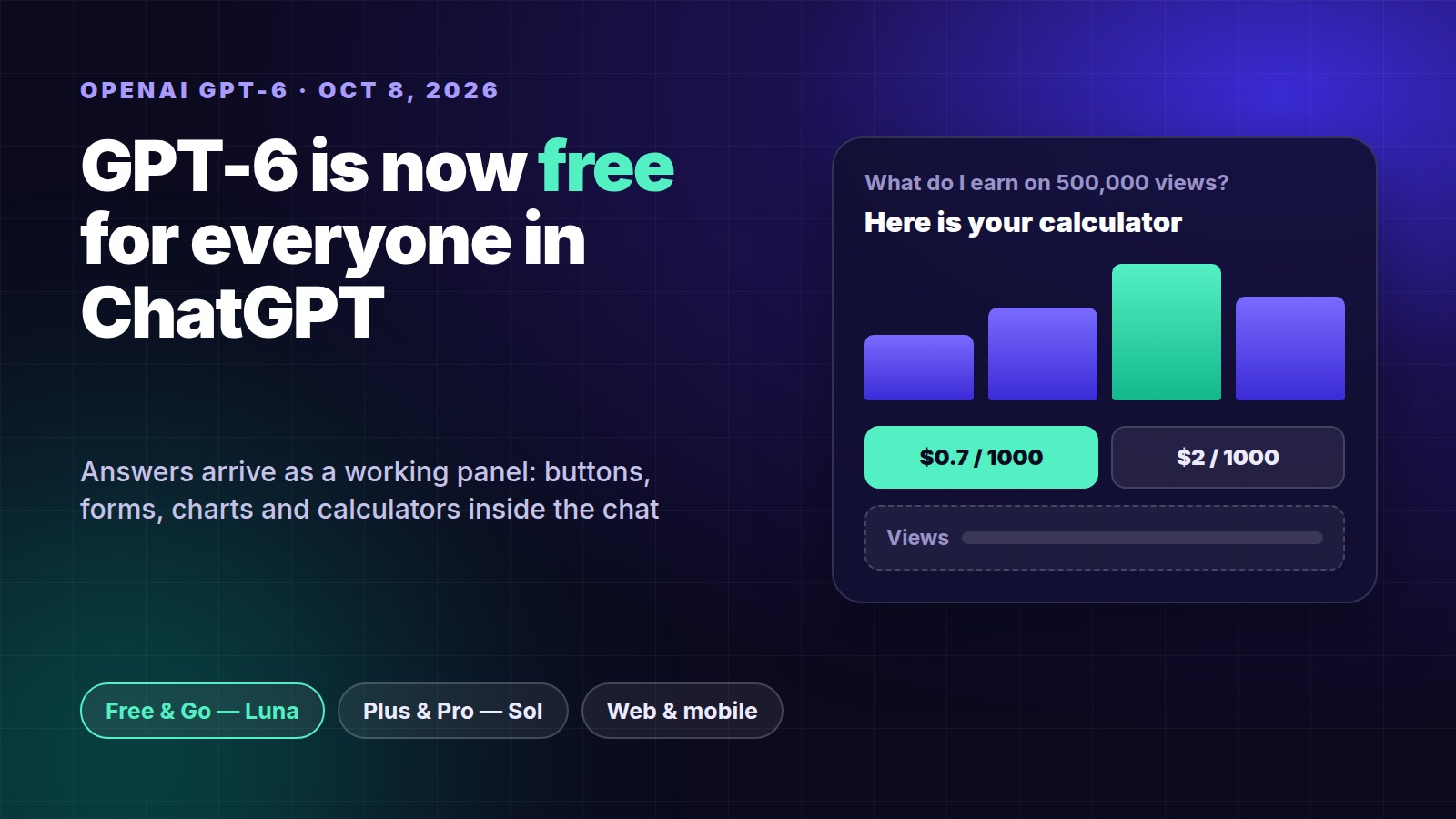
GPT-6 is now in ChatGPT on every plan, free ones included. Paid tiers get GPT-6 Sol, the Free and Go tiers get GPT-6 Luna. The model ships with Intelligent UI: instead of a wall of text, an answer can arrive as a working panel with buttons, forms, charts and small tools you use inside the chat. If you write hooks, scripts, descriptions and hashtags for short video, the free assistant you already use just got a serious upgrade.
What changed and when
OpenAI announced GPT-6 on October 7, 2026 and started the rollout in ChatGPT the same day, paid plans first.
| Plan | Model | Rollout started |
|---|---|---|
| Plus, Pro, Business, Enterprise | GPT-6 Sol | October 7, 2026 |
| Free and Go | GPT-6 Luna | October 8, 2026 |
The rollout is global, lives in the Chat tab, and covers both the web app and mobile. It arrives in waves, so some accounts saw it on day one and others a few days later.
Luna vs Sol
Luna is the compact, fast variant; Sol is the full-size one. OpenAI's own benchmarks put them close together. Independent measurements show a wider gap: according to Techloy, Luna streams around 127 tokens per second versus 85 for Sol, while Sol scores 48 against Luna's 38 on a composite intelligence index.
In practice: the free tier gives you the faster model, not the strongest one. For a 40-second script, a batch of hooks or a hashtag set, Luna is more than enough. For long multi-constraint reasoning, you will feel the difference.
Intelligent UI, in plain terms
Until now a ChatGPT answer was text, and the only way to interact with it was to ask again. Now the model picks the format. It can reply in text, or it can build a chart, a set of toggles, a form, a diagram or a one-off calculator for your exact question, right in the conversation.
Under the hood OpenAI built a library of native streamable interface components plus a compiler that renders the panel progressively while the model is still writing. So an interactive answer does not make you wait for the full response before anything appears.
What creators can do with that:
- compare options as side-by-side cards you can toggle, instead of three paragraphs of prose;
- get a revenue calculator for a pay-per-view campaign built in the chat, no spreadsheet;
- learn a topic from a clickable diagram rather than a long explainer;
- answer a clarifying question by tapping an option instead of typing it out.
The other GPT-6 upgrades
Beyond the interface, OpenAI highlights three changes that matter in daily work:
- faster time to first token on questions that need a web search (reported at roughly 44% faster by trade press);
- better risk recognition and stronger resistance to instructions hidden inside pages and pasted text;
- fewer unnecessary refusals on harmless requests.
That last one is the practical win for creators. Prompts like "write an edgy hook about my competitor's product" used to get bounced for no good reason, and you would spend three rewrites talking the model into a normal answer.
A 15-minute test for your own workflow
- Open ChatGPT and check the model name in the chat. No GPT-6 yet? The rollout is staged — give it a few days.
- Re-run your standard jobs on the new model: a script, five opening hooks, a caption, a weekly posting plan. Compare against what you got last week. That is the only benchmark that matters for you.
- Push the interactive side where you used to ask for a table: "build me a calculator for payout at $0.70 per 1,000 views", "compare three video formats by editing time".
- Fact-check anything that ends up on screen — dates, payout rates, campaign terms. The model is faster, not infallible.
- If AI touched the visuals and not just the words, mind the disclosure rules. We covered how provenance is actually checked in our piece on the SynthID detector.
Still unclear
- Daily message limits for GPT-6 Luna on Free and Go: OpenAI did not publish numbers, and free tiers normally have caps.
- Whether Intelligent UI expands beyond the Chat tab to the rest of ChatGPT.
- How interactive answers hold up in languages other than English on heavy tasks — so far there are only scattered reports.
For API work, trade press lists Sol at $2 per million input tokens and $10 per million output, with Luna at $0.10 and $0.50. Those figures come from reporting, not from the OpenAI announcement.
FAQ
Is GPT-6 free?
Yes, on the Free and Go plans, as GPT-6 Luna. The full-size GPT-6 Sol is on Plus, Pro, Business and Enterprise.
What is the difference between GPT-6 Luna and GPT-6 Sol?
Luna is smaller and faster, Sol is stronger on complex tasks. Independent tests put Luna at roughly 1.5x the output speed and below Sol on composite quality scores.
How do I get GPT-6 in ChatGPT?
You do not switch it on. It lands in the Chat tab on web and mobile as the rollout reaches your account — October 7 for paid plans, October 8 onward for Free and Go.
What is Intelligent UI in ChatGPT?
It is the model's ability to answer with a real interface — buttons, forms, charts, calculators — assembled inside the conversation, choosing the format per question.
Can I write TikTok and Reels scripts on the free GPT-6?
Yes, and that is the fastest way to judge it. Luna handles short-form writing comfortably; the gap with Sol shows up on long, constraint-heavy briefs. For tooling around the edit itself, see our roundup of AI video editors and our test of free AI video generation with sound.
Sources: OpenAI's announcement "GPT-6 and Intelligent UI for everyone" (October 7, 2026) and ppc.world's report (October 8, 2026).
On Prime Oracles a free assistant earns its keep on the dull part of the job: reading a brief, turning it into a script, and estimating payout before you commit. Open briefs sit in the "Content Rewards" section and are taken with the "Accept Task" button; brands post their own through "Create Campaign".