
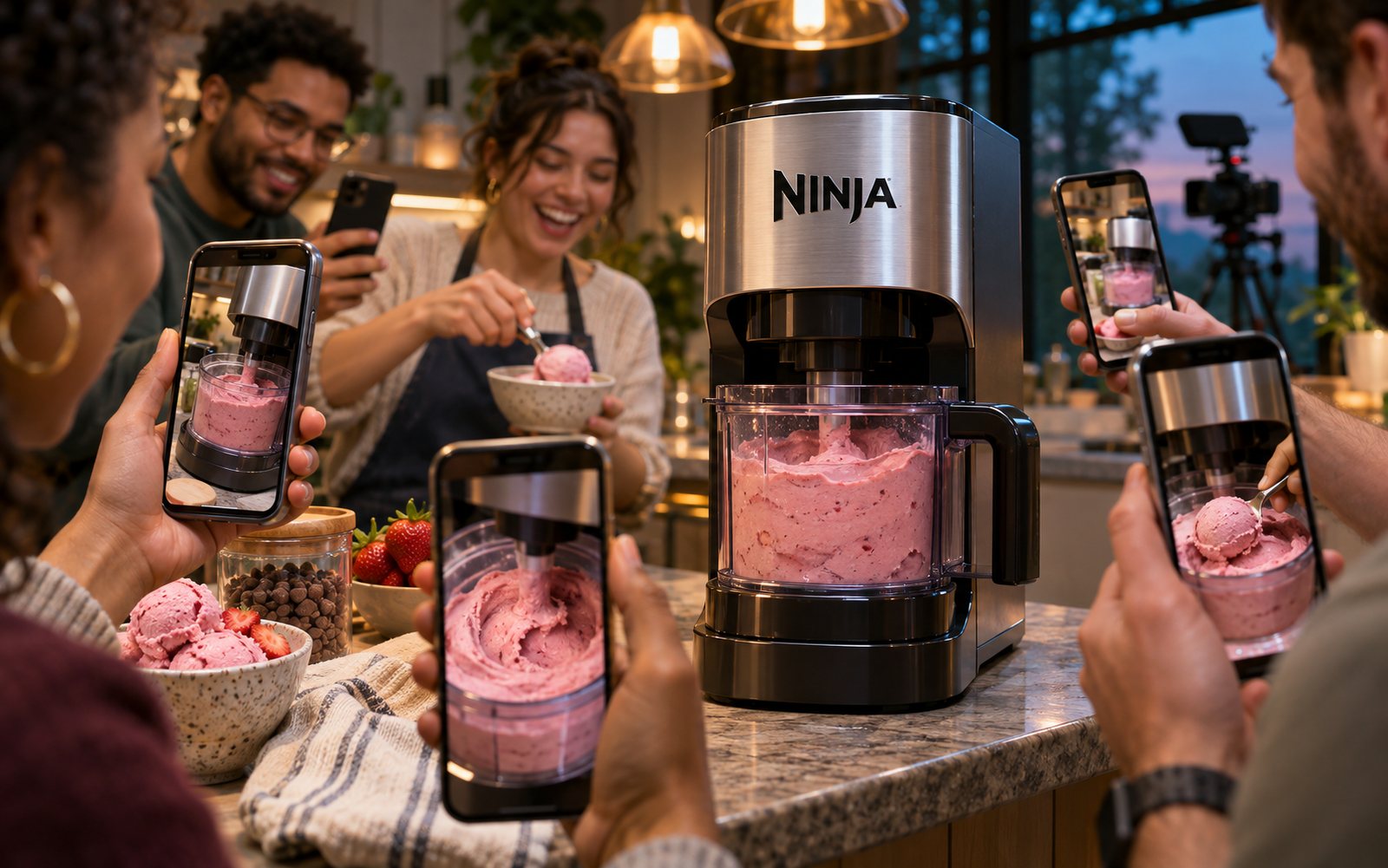
SharkNinja CEO Mark Barrocas revealed a number brands rarely share: of the roughly one billion social media impressions for the Ninja CREAMi ice cream maker in one year, the company itself accounted for just 2%. The other 98% came from customers. And it wasn't a slick ad that did the trick, but ordinary videos in the vein of "look what I made with this." We'll break down what he said, why showing a product in action generates more reach than traditional advertising, and what creators and brands can learn from this success story.
What the SharkNinja CEO Said
Mark Barrocas, co-founder and CEO of SharkNinja, was speaking at a leadership series hosted by the University of Miami Herbert Business School and consulting firm McKinsey. In response to a student's question, he shared figures for the Ninja CREAMi—a home appliance that freezes and churns a mixture into ice cream.
The quotes below are from a recording of the event, as reported by the industry publication Net Influencer (the article was published on October 30, 2026).
"Last year, the Ninja CREAMi had a billion social media impressions worldwide. A billion," Barrocas said. "Of those, SharkNinja was responsible for 2% of all impressions. 98% were just consumers telling other consumers, 'I bought this thing, and here's what I did with it.'"
Let's break that down into numbers.
| Metric | Value |
|---|---|
| Ninja CREAMi social media impressions in one year | approx. 1 billion |
| Share of company-produced videos | 2% |
| Share of customer videos | 98% |
| Appliance price | $199 |
Why It Worked: The Product in Action, Not a List of Features
This is the key takeaway, and it's not about budget. For the first year, according to Barrocas, the ice cream maker sold just "okay"—nothing more. The marketing at the time was built around what you put inside: "the ingredients you use, allergens, dairy restrictions."
Then, gym-goers got their hands on it. They started pouring their post-workout protein shakes into the container, freezing them, and showing off the result—a 230-calorie serving with 30 grams of protein. SharkNinja had nothing to do with this.
"And all of a sudden, with no involvement from SharkNinja—and this happens with a lot of our products—people start hacking our products," Barrocas said.
The difference between the two approaches is plain to see.
| What the video shows | How the viewer sees it |
|---|---|
| Features and ingredients | An ad to be scrolled past |
| A person making their own food and showing the result | A relatable scene to be watched and replicated |
Barrocas connected this to a principle the founders adopted back in 2008: to grow "one five-star review at a time." A consultant at the time called it "the dumbest idea in the world" for a boring category like home appliances.
"And what is that today? It's an Instagram post. It's a TikTok video," Barrocas said. "Maybe it's you just turning on your camera and for 30 seconds showing people: here's this incredible thing I made in my Ninja CREAMi."
From Late-Night Infomercials to the Top of TikTok Shop
The company started with infomercials: co-founder Mark Rosenzweig would demonstrate the appliances on TV shopping channels himself because they "just didn't have the money for other advertising back then." It was Barrocas's own children who changed his mind—around 2020, he said, they told him to "get off this infomercial thing" and get on social media. At the time, he didn't believe you could sell anything on social media.
Now, SharkNinja's stores are among the largest on the U.S. TikTok Shop. The figures below are cited by Net Influencer from the analytics service Kalodata.
| Month (2026) | Shop | Revenue Rank | Revenue |
|---|---|---|---|
| May | Shark Home | 2nd | $17.67M |
| June | Shark Home | 3rd | $14.48M |
| June | Ninja Kitchen US | 6th | $10.55M |
| August | Shark Home | 2nd | $12.91M |
| September | Shark Home | 7th | $8.33M |
In August, of Shark Home's $12.91 million in revenue, $12.30 million came from affiliate sales—that is, from purchases made through creator links. The average order value was $201.12, the highest in the top ten.
What the Company Did Next: First Fans and Storytellers
On October 20, 2026, SharkNinja announced the launch of two creator programs—an attempt to channel the spontaneous flood of videos into a structured, rewarded system.
| Program | For Whom | What It Offers |
|---|---|---|
| First Fans | Company employees (over 4,100 worldwide) | Training, resources, rewards, and affiliate commissions for eligible participants |
| SharkNinja Storytellers | Regular customers | Rewards, commissions, bonuses, and for the most active members, early access to unreleased products and a chance to influence their development |
In the same announcement, the company shared its overall figures: content from the brand and creators about its products had garnered over 19 billion impressions from more than 200,000 posts in a year, with the majority coming from the community.
The participation terms were not disclosed in the press release. According to Glossy, there are three tiers: for a standard creator, an 8–10% commission for unboxings and reviews; for a professional, 8–12% plus access to paid briefs and masterclasses; and for invite-only VIPs, 12–15%. The same report states that applications are accepted from those who live in the U.S. and have at least 1,000 followers in total. Applications are on the storytellers.sharkninja.com website.
Another detail from the company's Q2 earnings call: according to Barrocas, new AI tools have allowed SharkNinja to see over 60% of the organic content about its products. Previously, the company mainly tracked posts with its hashtags, which less than 20% of users include. Simply put, the brand was missing most of the conversation about itself.
What Creators Should Do
The main takeaway for creators is short and sweet: show the product in action, don't just recite its description.
1. Film the result, not just the product
Viewers watch to the end not for the unboxing, but for the "what happened next" moment. In the CREAMi story, the viral star wasn't the appliance, but the bowl of protein ice cream in the shot—and its recipe, which viewers could replicate.
2. Look for a "hack," not just the instructions
The most powerful videos are about unconventional uses. What the manufacturer intended is already in the manual, and a video about that is of no interest to anyone. The gym-plus-ice-cream-maker combo was the hack. Think about what your product can do that the brand doesn't mention in its ads.
3. Keep the format short and casual
Barrocas himself described the ideal format: turn on your camera and show what you made in 30 seconds. No studio required.
4. Take on paid briefs while the wave is hot
The one problem with a billion free impressions is that they're free. If you're already filming products at home, it makes sense to do it where you get paid for views. In the 'Content Rewards' section on Prime Oracles, brands post briefs, a creator hits 'Claim Task,' and gets paid for their video's views. Programs like SharkNinja Storytellers are a second, longer-term path: they offer a commission on sales, but for now, only for U.S.-based creators.
What Brands Should Do
1. Create briefs that ask creators to "show how you use it"
The SharkNinja story is an argument for the simplest brief possible. It's cheaper than shooting a commercial and yields content that viewers see as a recommendation, not an ad.
2. Don't stop people from getting creative
The company never planned for protein ice cream. It won precisely because it didn't try to correct its customers, and later adopted their use case in its own materials.
3. Learn to see the conversations about your brand
If you only track posts with your hashtag, you're seeing a fraction of the picture. For SharkNinja, this gap was massive.
4. Calculate what this kind of reach would cost
A billion impressions bought through advertising would have cost an astronomical amount. Assigning briefs to creators on a pay-per-view model is a middle ground between organic chaos and a media buy: on Prime Oracles, a brand can 'Create a campaign,' set the terms, and pay for the actual views the videos receive.
What's Still Unknown
- How exactly the billion impressions were calculated—SharkNinja has not disclosed the methodology or the tool used.
- What portion of these impressions the company was able to convert into sales.
- Whether the First Fans and Storytellers programs will be available outside the U.S. and when.
- The exact commission terms—they are not in the press release; the 8–15% tiers are known from the Glossy report.
FAQ
What are UGC videos, in simple terms?
These are videos created by users themselves, not the brand: unboxings, reviews, and everyday scenes featuring the product. They are filmed on a phone and posted from a personal account.
Why does UGC work better than ads?
Because the viewer sees a result from a person just like them, not a promise from a brand. In the case of the Ninja CREAMi, user videos generated 98% of the impressions, even though the brand spent no budget on them.
How much do UGC videos pay?
There's no single rate. Affiliate programs pay a percentage of sales from your link (for SharkNinja Storytellers, it's 8–15%, according to Glossy), while platforms with briefs pay a fixed rate per 1,000 views. We broke down how these payments are calculated in our article about how much clippers get paid.
How long should a UGC video be?
Short. Barrocas describes a working format as 30 seconds with the camera on. You can see what happens to the longevity of promotional UGC videos at scale in our analysis of 8,107 Meta ads.
Do people really buy products after watching video reviews?
Yes, and this isn't just a Western phenomenon: according to a Russian survey, 47% of shoppers made an unplanned purchase after watching a video review—more details in our separate article.
Prime Oracles is a platform where brands post briefs for short videos, and creators can claim them and get paid for views. This is the exact mechanism that the Ninja CREAMi story illustrates from the other side: a product in action, filmed by a real person.