
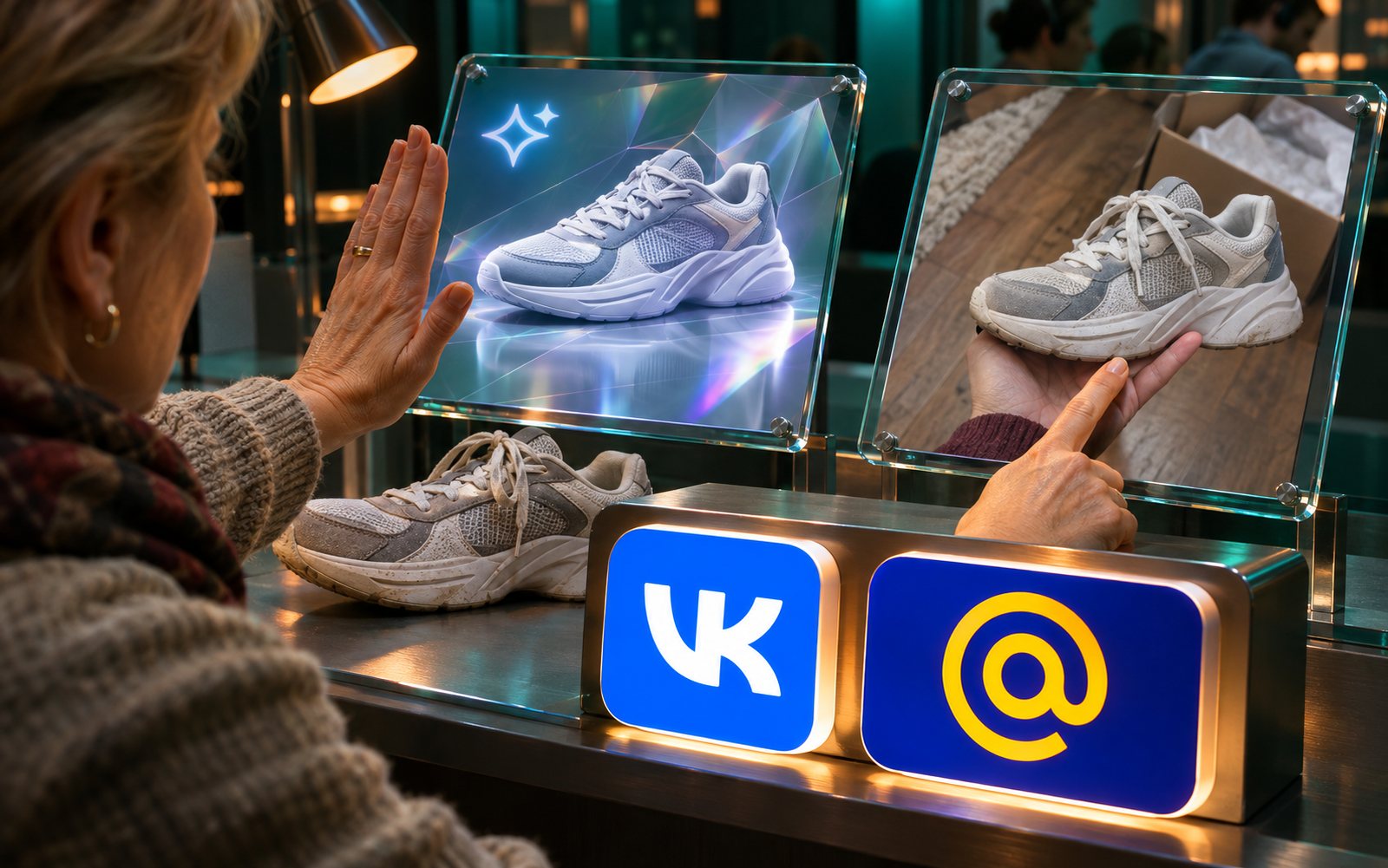
In October 2026, VKontakte and “Nauka Mail” surveyed 9,104 people on how they choose products online. Nearly half—46%—have a negative view of AI-generated images and descriptions, while only 1% react positively to such content. Meanwhile, 30% of shoppers trust photos and videos shot by regular customers—six times more than they trust professional studio shots from brands.
For short-form video creators, the numbers send a clear message: an amateur video about a product performs better than a polished, expensive image. For brands, it's a reason to re-evaluate where to invest their budget: in generating visuals or in commissioning creators.
What Shoppers Trust in a Product Listing
Participants were asked what inspires their trust in a product. The responses were distributed as follows:
| What Builds Trust | Share of Responses |
|---|---|
| Customer reviews in posts and comments | 33% |
| Customer photos and videos | 30% |
| Recommendations from friends and acquaintances | 12% |
| Professional studio photos from brands | 5% |
| Videos from brands | 3% |
The top two items add up to 63%. This means nearly two-thirds of shoppers rely on content created by people just like them, rather than on materials from the seller. Content from the brand—studio photos and videos—nets a combined 8%.
Attitude Toward AI: 46% Against, 1% For
A separate question addressed content generated by neural networks. 46% responded that they have a largely negative view of it, while only 1% view it positively. The remaining responses were not detailed in the “Nauka Mail” publication, so they likely represent neutral stances or those who were undecided.
It's important to understand the context here. The survey asked about AI content within a product listing: an AI-generated photo of an item, an AI-drawn “model” wearing clothes, or an automated description. This wasn't a question of “do you like AI in general”—a person might use AI every day but still not want to see its work where they need to understand what an item actually looks like.
What Drives a Purchase vs. What Stops It
Factors that influence the decision to buy:
| Factor | Share of Responses |
|---|---|
| Rating and customer reviews | 22% |
| Attractive price | 21% |
| Detailed product description | 20% |
Reasons for abandoning a purchase:
| Reason | Share of Responses |
|---|---|
| Bad reviews or a low rating | 25% |
| High price | 19% |
| Long or expensive shipping | 12% |
| Lack of reviews, photos, or videos | 11% |
| Doubts about the seller | 9% |
| Complicated return policy | 7% |
The line “Lack of reviews, photos, or videos”—at 11%—is a direct financial argument for brands. One in nine shoppers walks away not because the product is bad or expensive, but because there's nothing to see about it.
Purchases Aren't Immediate
40% of respondents add an item to their cart and come back to it later, while another 33% think about the purchase for a day or several days. The decision is almost never made in a single visit.
For a creator, this means a product video acts less like a “buy now” button and more like a piece of evidence the person will revisit a day later. Therefore, it's more important to show the product in action in a review than to push for urgency.
Men and Women Look for Different Things
According to the survey, women more often noted reviews, photos, and videos from other users, as well as advice from friends. Men more often relied on expert reviews, brand recognition, and detailed specifications. Men tend to need less time to make a decision, while women are more likely to think about a purchase for a day or several days.
“Nauka Mail” did not provide specific numbers for this breakdown—only the general trend.
What Creators Should Do With This Data
- Shoot like a customer would. Even lighting, a normal room, the item in your hands. The goal of the video isn't beauty, but to answer the question, “What does this look like and how does it work in real life?”
- Show the size and material. This is why people look at others' photos: a studio shot doesn't convey the item's true color or how big it really is.
- Don't hide the flaws. The top reason for abandoning a purchase is bad reviews (25%). A video that honestly states who the product isn't for builds more trust than one filled with endless praise.
- Tackle products with few reviews. 11% of shoppers leave due to a lack of photos and videos—which means the demand for reviews on those products is higher.
- Use AI for editing, not for the shoot itself. Subtitles, cutting clips, cleaning up audio—that's fine. Generating the product itself instead of filming it is exactly what turns off 46% of shoppers.
What Brands Should Do With This Data
- Compare the cost of generating visuals versus commissioning creators. According to the survey, professional brand photos build trust with 5% of shoppers, while customer photos and videos build trust with 30%.
- Gather several different videos for a product listing, not just one perfect one. Different people, angles, and settings will address more potential objections.
- If you use AI in your listings, label it. Undisclosed AI generation that a customer spots will damage trust more than an honest label.
- Track abandonments, not just views. If customers are leaving a listing due to a “lack of photos and videos,” the very first videos you add will have a noticeable impact.
What's Still Unknown
“Nauka Mail” published the results without some methodological details: the age and geography of the participants were not specified, the remaining responses to the question about AI content were not broken down (46% against and 1% for doesn't add up to 100%), and no figures were provided for the differences between men and women. The survey was conducted online via VKontakte and Mail services, meaning it reflects the behavior of users on these platforms, not all shoppers in the country.
Additionally, the publication provides no data on whether shoppers can actually recognize AI content. The question was about their attitude toward it, not their ability to distinguish it.
Frequently Asked Questions
Can I use AI in a product listing on a marketplace?
The platforms themselves don't forbid it. But according to the VKontakte and “Nauka Mail” survey, 46% of shoppers have a largely negative view of such content, while only 1% view it positively. It's safer to use AI where it doesn't replace the image of the product itself: for backgrounds, image processing, or description text.
Who do shoppers trust most when choosing a product?
Reviews from other customers (33%) and their photos and videos (30%). Professional brand photos get 5% trust, and brand videos get 3%.
Why do people abandon their purchases?
The main reason is bad reviews or a low rating (25%). This is followed by a high price (19%), long or expensive shipping (12%), and a lack of reviews, photos, or videos (11%).
How many people buy immediately?
Most don't. 40% add the item to their cart and return later, while 33% think about the purchase for a day or several days.
What is a UGC video about a product?
It's a video shot by a regular person, not a studio: an unboxing, a review, showing the item in use. Brands commission these videos from creators and feature them in product listings or ads. Learn more in our article What is a UGC Creator and How to Start with No Experience.
More on This Topic From Our Site
- Video Product Reviews: 47% of Russians Make Unplanned Purchases
- Does Instagram Cut Reach for AI Videos? Mosseri's Answer and AI Labels
- Influencer Marketing in 2026: Brands Allocate 15–25% of Budgets to Creators
Source: “Nauka Mail”, results of the VKontakte and “Nauka Mail” survey.
On Prime Oracles, brands post briefs for shooting these types of videos, and creators can find them in the “Content Rewards” section to get paid per view.